Interview: Jon Lowery, St. Thomas men's coach
|
Other Interviews:
|
D3Soccer.com had the opportunity to interview the coaches of the four men’s teams heading to the Final Four. Jon Lowery, head coach at St. Thomas, spoke with Ryan Harmanis about the Tommies’ program, season, and success.
|
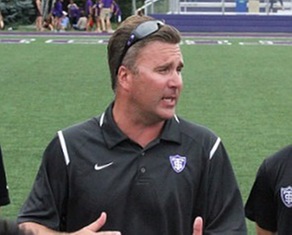
| Jon Lowery - 5th-year head coach of St. Thomas Tommie Sports |
Ryan Harmanis: Coach, this is an exciting time for your program. Congratulations. I’m sure things are a bit crazy with the tournament, Thanksgiving, then two weeks off. How are you handling it?
Coach Jon Lowery: Thanks, I appreciate that. Yea, it’s been a little weird. The tournament got rolling, and then we had two successive weekends where you’re just so laser focused, and your team is so emotional, it’s just tournament soccer. And then to leave Chicago [where the Tommies won their Sectional to advance to the Final Four] and to have to let the guys go—maybe it’s me being a bit of a control freak [laughs] but it was kind of a hard process. To tell the guys, “Hey, we’re going to come back for the biggest game of our lives in two weeks, but in the meantime, we won’t see each other for four or five days.”
RH: It’s definitely a little different. Do you have any plans on how to mitigate any issues with the time off?
Coach Lowery: The way we’ll mitigate that, to start, I’ve been texting and staying in touch with the guys on a regular basis, I’ve had conversations with a lot of them. But I want to be respectful of their space and their time with family and friends. The only silver lining in the process is that it’s so late in the season that there’s not a lot of stuff for us to put in, there isn’t a lot to redevelop. We need to keep doing what we do well, and we need to do it better than we have, and in the meantime it’s a bit of a blessing because we can get healthier than we’ve been since preseason.
RH: You mentioned how big this next game will be, but there’s an argument that every game you’ve played since the conference championship [a 1-0 win over Macalester] has been the biggest game in your program’s history. You win your first conference tournament title, get a deserved high seed, and you just keep winning. On one hand people are calling you Cinderella, but on the other you’ve won 20 games, so this is no fluke. How have you managed expectations while balancing the fact that this is a new experience for everyone?
Coach Lowery: I would say this: we’ve been very honest about the process, but this didn’t sneak up on us. We’ve been talking about this for four or five years, about putting this program on a platform where we can win the conference, compete in the region, and ultimately compete nationally. Is it new to us? Absolutely it is. But it’s something we’ve worked toward for a long time, and I think the way we’ve phrased it within our program is that we need to become comfortable in our new reality, and what we’re hoping is that our new reality is being a national contender. I don’t want that just to be 2016, I want that to be year-in, year-out.
So it’s been fun to see these guys develop, to see these guys mature, to see this level of leadership we have with our seniors. I’m just very proud of what they’ve done, and to speak to every game being the biggest game we’ve ever had, that’s true, but we’ve really taken it in stride. This may sound boring, but we’re just trying to get better, we want to be a better team tomorrow than we were today.
RH: Your team really reflected that approach throughout the tournament, because you were in some tough spots. You’re down 1-0 in the first round [against St. Scholastica] with three minutes to go. You’re down against Redlands 2-0 [in the Elite Eight] in the second half. How were you able to deal with those ups and downs?
Coach Lowery: Well, we’re not Cinderella, in that I think we’re built to last, we’ve won 20 games, but at the same time we aren’t playing teams off the field. We want to defend well, we want to play when we can, we want to attack responsibly, we want to be really good in transition, and then we want to manage games. And we’ve done that. So whether it’s the conference final or it’s Scholastica or whoever, it’s been classic college soccer. You’re playing teams with their backs against the wall and everything on the line, and you know it’s going to be close, but we’ve become extremely comfortable in close games. That’s kind of hard to define, but it’s become a huge characteristic in getting us to where we are.
RH: Exactly, and the thing that really stands out to me is that you won’t beat yourselves. You avoid major mistakes, you understand the game situation, and you’re very controlled in your approach. So can you talk how you’d ideally like to see your team play, and compare that to how it’s playing now?
Coach Lowery: I think there are two sides to it. I think, one, as a college soccer coach, you want to continually define how your program is playing. We want to play, it’s an overused term, but we want to play attractive soccer. We want to keep the ball, we want to penetrate, we want to score goals, we want to defend well, but we really want to push that, similar to what some of the bigger programs in Division III have done. A lot of that is what I learned from [being an assistant coach at] Wake Forest under Jay Vidovich, and I don’t think anyone can argue with the style of play they had in the mid-2000s. So that’s what I really want our program to look like.
But I’ll turn that on the other side and say I’ve also learned a lot about tournament soccer. You have to be careful. If you try to play too much, or if you get caught up with some of the process of what you want to do, whether it’s with or without the ball, you can get burned. And it’s a one-and-done situation. So my philosophy this year was to take our program to another level with how we want to play. That will hopefully carry over for years going forward. But I also wanted to prepare us for what tournament soccer looks like, so we could be ready to win games in the tournament. Because I think your overall philosophy and how you approach a single knockout game are two different things.
RH: You mentioned being at Wake Forest, and I have a question about Division I versus Division III. Having coached at Wake Forest and Ohio State, how would you compare the level there to what you see in D-III? And then what have you taken from there to here?
Coach Lowery: Whew, that’s a big question. What I’ve tried to do is take something from the coaches I’ve worked with and the programs I’ve been in. John Bluem [at Ohio State] might do it a bit different from Jay Vidovich [at Wake], and the style of play might differ a bit, but everyone’s after results, and they get them. I wanted to find a practical sense of soccer, where we could connect passes, keep the ball, attack well, and “win style points” if you’re looking from afar. But at the same time I want it to be done in a practical way that translates to Division III soccer. And the goal here isn’t to play the prettiest style, it’s to win the national championship. But I don’t think it’s an either-or thing, I think there’s a balance where you can do both.
We’ve played teams at this level where I’m shocked at how they play, and others where I’m impressed. Everyone does it their own way, and we’re developing our own style and looking for results at the same time. And we want to play in a way that will continue to pique the interest of talented players that we recruit, that will pique the interest of the fans and the people that support our program. But it’s such a delicate balance to do both of those things, especially at this point of the season, where every game is one-and-done.
RH: That leads to a question about program building. You explained your vision for your team, but how do you approach recruiting? You want to sustain this at a national level, so (1) what have you done to get there so far, and (2) how much does making a Final Four help that cause?
Coach Lowery: I was very fortunate to be around some good coaches. Being from Minnesota, one of the original people that piqued my interest in this game and how to do it was [former Minnesota Thunder coach] Buzz Lagos. He’s a local legend, but people around the country might not know him that well. But he was a caring, smart, and thoughtful coach that really opened up what you could do as a team. And then my high school coach, Chuck Scanlon, I just couldn’t be around him enough, he was just such a competitor, and really stoked my will to win. Then I went to graduate school at UMass-Amherst with Sam Koch, then the years with John Bluem and Jay Vidovich, and then the players as well. I’ve also studied other coaches. I just like to learn soccer. I can’t read enough, I can’t watch enough, I just like it.
Then to come to St. Thomas, which is really unique. If you look around our athletic department, men’s basketball just won a national championship, the football team has been there, our athletic director, a great mentor, he won a national championship, softball has won a couple, volleyball has one. So I come to work every day surrounded by a group of colleagues that know nothing but success at this level. And I have a deep appreciation for what college coaches do, whether it’s basketball coaches or football coaches or any other sport.
The common denominator that I’ve pulled out of it is the importance of culture. We’re not building an all-star team here at St. Thomas, we’re not going to go to the main events for club soccer and pull the best player on every field. We want to find kids that fit our program and our University, that are academically inclined to succeed here, and that are talented. But we put importance on guys that are selfless, self-motivated, and then buy into what we’re doing at St. Thomas. I think it’s a fun time to be here, because we’re doing things for the first time. The guys don’t want to hear it, they’re 18- to 22-year olds, but I talk about legacy, I ask them, “What do you want to leave here for future players?”
So I think what this Final Four has done is validate the commitment and effort that our players have put in over the past four or five years, and hopefully inspire future players to be a part of it. And then it’s our job to make sure that they fit what we do, our culture, what it means to be a St. Thomas soccer player. And if we do that and they do that then I think we’ll have sustainable success.
RH: That’s how programs rise. Transitioning to your team, I’ve always felt that teams develop a distinct personality every year. What’s the personality this year?
Coach Lowery: Well I’m getting older [laughs], so my finger might not quite be on the pulse here, but this group has been maturing for four years. And we have four fifth-year seniors in our lineup. So what Mark Heydt has been doing at left back, what Johnny Mulhavill and Shane Marshall have been doing at center back, and what our other seniors have been doing, Amos Nash in midfield and Grant Larson in goal, and then our super-sub Tony Kuplic, they’re leading by example.
So it’s been a really interesting year, because my first few years I felt like I had to do everything. I had to tell them everything, show them everything, I felt like I had to be the one person that could tell them how to do things. But starting last year, and especially this year, there’s been a handing off. I’ve really trusted the upper classmen to run this program, and it hasn’t been the easiest thing for me personally, because that’s new for me as a coach, but what they’re doing on and off the field speaks volumes to where we’ve grown as a team. And as their coach, I know that they know how to win games. And I know that they know our process. And that’s where the level of trust in our program translated into a very successful season.
RH: Transitioning then to specific pieces of your team, the thing that struck me is how well organized your team plays in the back. You tackle well, they’re good one-on-one, but it’s amazing how they stay connected at all times. How good have those guys been all year, and how does it feel when you know the defense will keep you in every single game?
Coach Lowery: Honestly, I feel very fortunate to have survived last weekend, where we gave up some soft goals, because that’s just not who we are. So going into next week that’s one thing we’re focused on, making sure that we aren’t conceding like that, because those were three goals we just haven’t given up all year. But big picture, the guys have done a really nice job of using their individual characteristics and their teammates around them to build a collective trust in how we can play. Our goalkeeping has been very good, both Grant Larson and Aidan Hogan have been tremendous. I was a goalkeeper, so I know what it’s like to have a team in front of a goalkeeper that really feels comfortable in the guy between the posts. It lets the guys think, “We don’t have to be perfect, so let’s do what we do, let’s stay compact, let’s stay out of bad positions, and that’s all it takes.”
It’s been a process over several years, but now we’re battle-tested. The Luther result, for me, was validation, because that’s a really good team, but we kept a clean sheet and scored two goals. If someone asks me how we play, I’d tell them to watch that game, because that was a really good example of what we want to be.
RH: Now to the offense, you look at the goals and assists, they’re really spread around. Do you enjoy that, because it means that teams can’t just key on one guy, or would you prefer to have a go-to player that you can always rely on?
Coach Lowery: I couldn’t like our situation any more right now. Whether it’s Mark Heydt at left back, who led our entire conference in points [7g, 10a], or Pierce Erickson, who only has two goals but is a really good target and can get the job done, or Christian Elliehausen, who scored a great goal against Luther and then the key goal against Benedictine and created some unbelievable goals for us. So I love the diversity of what we’re doing. And we spoke about close teams earlier, I think this gives our team a sense of belief where we know it doesn’t have to come from just one spot. So we know there are multiple places we can get production, and when you’re in a close game, that gives us a high level of comfort.
RH: On that note, I need the story behind Tony Kuplic. Was he injured? He’s only played in twelve games, started none, and then he scores five goals in four NCAA games.
Coach Lowery: [Laughs] Tony was not injured. Tony is a senior walk-on. The short version of a long story is that we bring in our pre-selected roster for preseason, and then we let any players that want to walk on come to an open tryout beginning the first day of class. And then if anyone from that tryout raises some interest, we bring them to team sessions. A couple of years ago Tony came to that tryout, but we didn’t think it was the right fit at that time. But sure enough, this year as a senior, he wanted to go for it again.
He’s an amazing athlete, and he’s got an unbelievable attitude, but I didn’t add him at the time because I had any idea he’d score five goals in the NCAA tournament. I added him because I thought he would make our culture better, and because he brought things to our attack that we didn’t have. And it took time, it took almost the whole month of September for him to get comfortable in our training environment, with the speed of play, with the guys. In October we found some time to get him on the field, get him adjusted, but since then, wow.
Against St. Scholastica we had one foot in the grave, probably an arm in there too, and we looked down the bench at him and said, “Tony, go make something happen.” And he did, [scoring the game-tying goal], and I think he deserves a ton of credit and I think his teammates deserve a bunch of credit for embracing what he can do and what he brings. It’s just one of those special things that happens in sports.
RH: And how about that goal, the one that sent you to the Final Four [over Redlands 3-2 in overtime]. What a strike.
Coach Lowery: Yea, it was unbelievable. And the best part is his movement. There’s a very acute moment in that attack where Elliehausen is penetrating through the middle of the field and Tony is flirting with being offside. He does an amazing job, a very high-level soccer IQ, to bend his run and loop back underneath the line, then he gets the ball, and the speed of delivery for him to get the ball off his foot, it was unbelievable.
You sit around daydreaming about making the Final Four, and I always pictured running around on the field like a maniac, and I couldn’t even move. The level of sophistication he produced in five or six seconds to help us move on, I can’t explain.
RH: We talked a bit about mentality, but there’s a lot of fanfare and distraction at the Final Four. How do you keep your guys focused on the task at hand?
Coach Lowery: We’re going to be very detailed in our days, in what our preparation looks like. We won’t let anything overwhelm us. Having said that, I really want our guys to enjoy this. There will be a lot of parents there, a lot of friends, and I do want them to enjoy this and experience what it’s like to be one of the last four teams in the country. But I want us to take advantage of the opportunity. So I’m leaning really hard on the experience I had as a coach with Wake Forest in 2007 and 2008 when we went to the Final Four. We did the travel, the commitments, the players getting exposed to other things, so I’m leaning on that. I’ve talked to coaches and players that have been there in the past, and my job is to have them ready. So I want to have a detailed plan that’s respectful of the guys enjoying the experience, but that puts us in a position to be comfortable and take advantage of the opportunity.
RH: Another aspect of preparation, what have you done to get ready for Tufts? They’re a program that grew similarly to yours, they were getting there, and suddenly they go from “good enough to make the tournament” to “national champions” in one year. Then they make the Sweet Sixteen last year and they’re back in the Final Four. How do you see the matchup?
Coach Lowery: Well, I know as much as I can right now, and that work will continue. I have a ton of respect for what they’re doing, I’ve looked all the way back to how they won it in 2014, and I think what they’ve found is what I spoke to earlier. I like how they play, but they also have characteristics that make them a very difficult knockout team. Whether it’s set pieces, or scoring off a long throw [how Tufts beat Kenyon in the Elite Eight]. They’re extremely athletic, and they don’t give away cheap goals, or really anything lately. I think they’re similar to us, we’re both built for this tournament, built for this game, and we’re going to continue to look at us and at them to put the best plan together. But they’re a terrific team, and when you look at the other side, a terrific Final Four. And people might say it’s a bit “lower profile” than usual, but I think all four teams really deserve to be there.
RH: One final Final Four-specific question: If there’s one aspect of the game you need to do very well in to be successful, what would it be?
Coach Lowery: I’m going to say two, because one isn’t really confined to what it means to be a good soccer team. One is our mentality, because honestly, we’re going down there to get better. We want to go down there and hopefully get two more games where we can build on what we’ve become. And I feel really good about the first eleven we’ve put out there the last few games, but one area where I have confidence is that we have guys that haven’t been starting who can make a major impact. From what I’ve seen in the past, teams that get contributions from their reserves, from their bench, they usually figure it out over 90 minutes. So I think if mentally we stay in the moment, and then we have a group of guys coming in off the bench who can make a dramatic impact, that’s what I’m looking for.
RH: Last substantive question. Most teams have a player or two where the stats might not be there, they don’t get accolades, but they’re essential to the team. Do you want to speak about someone on your team like that?
Coach Lowery: Yes, and I really like that question. Look, you know teams and programs, and you know that guys like that are just vital to any team’s collective success. Mark Heydt got conference Player of the Year, and everyone knows what he can do, but I think two of the guys I’m most proud of are our centerbacks, Johnny Mulhavill and Shane Marshall. They have been consummate professionals, they’ve been incredibly statistic. They’re not lighting up the box scores, and they won’t be drafted in January by MLS teams. But the leadership they’ve provided and the buy-in they’ve given this program as fifth-year seniors, and to have them anchoring our back line, for my money, has been the most important aspect of who we are.
RH: I’ll close with a question that’s a little random. Do you think being a goalkeeper has played any role in your success as a coach? You were a goalkeeper, Coach Souders at Calvin was a goalkeeper, do you think that’s a meaningful characteristic, or just an interesting fact?
Coach Lowery: I think that’s a cool conversation to have, to think about. When you’re in those moments in goal for year after year, and you see the game from that perspective. I mean let’s be honest, you’re really not that involved in the game [laughs], so you’re processing the game, from a mental aspect, much differently from the guys on the ball the whole time. So I don’t know. There are coaches around the globe with goalkeeping backgrounds, but I think the big thing is the experience you’ve had with the game and how you mold that into your group and continue your efforts to build your program.
I won’t say goalkeepers make better coaches, we’ve hit our heads on the post a number of times and it could be the opposite, but for me it’s personal. I knew very early on I wanted to coach, so even when I was playing at Ohio State, or [professionally] with the Minnesota Thunder and Carolina Dynamo, I had that subconscious approach to look at teams, look at systems, and judge what’s successful and what isn’t. So I’ve parlayed that with what I’ve learned makes programs successful on the field and off it. To answer the question, it can’t hurt, and personally it was a way for me to learn and process and create a philosophy that I’ve been able to use as a head coach.
No. 13 St. Thomas (20-1-3) takes on Tufts (13-5-2) in the first NCAA Men’s Semifinal at 11:00 AM on Friday, December 2nd.
|
Other Interviews:
|
Comments or feedback for the author? E-mail Ryan Harmanis.