


December 1, 2015
Interview: Justin Serpone, Amherst men's coach
|
Other Interviews:
|
D3Soccer.com had the opportunity to interview the coaches of the four men’s teams heading to the Final Four in Kansas City. Justin Serpone, head coach at Amherst, spoke with Ryan Harmanis about winning one for players that came before, as well as the Lord Jeffs’ high-energy style of play, leadership, and ability to grind to the Final Four.
|
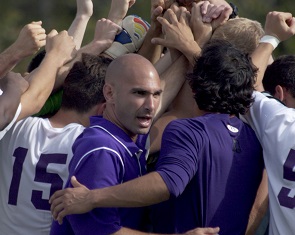
| Justin Serpone - 9th-year head coach of Amherst Amherst Athletics |
Ryan Harmanis: Congratulations on reaching your second Final Four! Can you comment on the NCAA tournament so far?
Coach Justin Serpone: Yeah, we’ve played three good teams. I think we probably played our best game all year against Trinity [in the Elite Eight, a 1-0 2OT win]. I was really pleased with the performance last Sunday. But it’s been hard, you know. Morrisville State was very talented; Lycoming was on a 20-game win streak; Trinity hadn’t lost in months—three good opponents and three good games, so we’ve done well. This group has a lot of resolve, and I’m pleased that we’re still practicing and have the opportunity to play again.
RH: You lost in the NESCAC quarterfinals. What kind of impact did that have, in either direction? You no longer have the pressure of being undefeated and you get two weeks to practice, but you never want to lose a game.
Coach Serpone: You never want to lose a game, obviously; any team and coach in any sport would tell you that. But this year’s been challenging from an injury perspective. I don’t know in my nine years if we’ve ever had this many injuries. We never talked about being undefeated, but the loss allowed us to get a couple of key, key guys healthy. So it gave us a couple weeks to nurse some injuries, but I’d certainly have rather tried to win a NESCAC championship and be playing. I could try to rationalize it [laughs], but really we just tried to make the best of it.
RH: Looking at this year’s team, you’ve had extremely talented teams in the past. What do you think is different about this team, where they’ve been able to reach the Final Four, when others have fallen in the Elite Eight [in 2012 and 2013] or before that.
Coach Serpone: I think every year is different. You know, I said after the game on Sunday, I was 70% so pumped for our guys and 30% bummed out that the guys from 2012, 2013, those years didn’t get to practice a few more weeks. The culture of our program is something that isn’t a year-to-year, game-to-game type thing. We’ve been doing the same stuff, and we’ve had unbelievable student-athletes who just work so hard. In 2012 we hit the crossbar five times against Williams [in a 0-0 penalty shootout loss in the Elite Eight], but it just didn’t happen for that team. But you learn things, and from a coaching perspective, from an organizational perspective, everything is built on what happened before.
My message to those guys—and there were probably 25 of them from 2012 and 2013 here last weekend—I brought them in after the game and just told them that that win was for them. There’s just no way we’d have had the success we had this year, winning that game, reaching the Final Four, without their sacrifice and hard work. So making them aware of that is really important to me, because it’s the truth. This is a snapshot in this long book that I think is Amherst soccer, and you don’t just pick it up halfway into the book. I’m just so proud to be associated with all of them.
One of the common denominators when you get to this point in the year—as I was exchanging e-mails with Paul McGinlay [head coach at Trinity]—is that it’s not about teams, it’s about programs, it’s about culture. You go down the list, those teams are there every year because it’s not about an individual team or player. It’s about what they’re teaching in the aggregate, and what we’re trying to create is what those great programs like Trinity and Ohio Wesleyan have had.
RH: On that note, building and preparing based on what you’ve done before, is there anything you’re doing differently this year, or do you just approach it as another game?
Coach Serpone: That’s a great question. You can’t just approach it as another game—it’s impossible for guys; you can’t ignore the moment. But I think the game will be won or lost, not by the lights, but by who wins second balls, who beats their man down the field in transition, who can get a toe in or block a shot. I think focusing on the little things is what we’ll try to do, and try to not get too carried away. It’s about execution: can you execute your game plan? Are you better at the things you’re good at than the opponent is at the things they’re good at. I think that’s where our focus will be.
But I also think it’s important to point out that this isn’t my team. I’m the coach, but at this point it’s not my team: it’s the seniors’ team. At this point, the best thing I can probably do is stay out of the way [laughs]. You have to know your group, and we have a really mature group. I just think the world of our seniors and upper classmen, so they’ll dictate the energy and what goes into this weekend. I just need to support them and do what I can, but this will be their weekend.
RH: Shifting to talk about your team, the spine is just so strong. Starting in the back, defense has been a calling card for your teams. Can you talk about Thomas Bull in goal, and then how your team approaches defending from all eleven positions?
Coach Serpone: Thomas—wow! I think he broke the record for shutouts in the Lycoming game. And he’s fantastic, but it’s just so misleading. We’ll look at the record book in a few years and it’ll say “Thomas Bull”, but there have been so many people that are part of a record like that. Starting from the front, it’s how we pressure. Defending is an eleven-man thing, it’s not just your goalkeeper and your back four, you need everyone just digging in. That’s something we focus on, and it certainly helps to have Thomas back there, because he has been absolutely terrific all year, his whole career. He bails you out whether it’s making a save, grabbing crosses. I think he has all the tools to be a professional goalkeeper. We’ve been talking to MLS teams to hopefully get him a look going forward, but all I can say is that I’ve been very lucky in goalkeeping. Thomas as a leader has just meant so much to the program, and I’m really proud of him because he’s just this terrific, interesting guy. He’s infectious to be around and it’s been a fun four years with him back there.
RH: Moving up front, you have Nico Pascual-Leone. I’ve seen some of the fantastic goals he’s scored, and then he pops up with the winner against Trinity. What has he meant to your team?
Coach Serpone: You know, he’s another one who’s just an awesome kid. As good as some of these guys are as players, I think that they’re even better people. Nico’s kind of the man, he’s an RC, he’s involved in a bunch of clubs, he’s just this positive guy. I don’t think he’s ever had a bad day in his life. And then his brother’s on the team this year, so that’s been fun for the two of them. As a soccer player, he’s just different. When we were recruiting him, he was this technical kid, but “Is he tough enough?”—we weren’t sure. But his club coach told me, “Look, you’re overthinking this. He’s going to be a star.” He was right.
One of the things I’ll say: as good as he is attacking, scoring goals, playing a killer ball, he’s just as good of a defender, pressuring and winning balls. He’s as tough of a kid as I’ve ever coached, and that’s that maturation process. You hope over four years people gain something, and he may be the one who improved the most. I think he’s the best player in the country for what he gives us from a work rate, 50-50 balls, and then, obviously, we’ll take the goals. He’s another guy who transcends just being a good player with what he’s meant to this program, and I know we’ll be friends forever even once he’s done playing. His smile on Sunday was just ear-to-ear for six hours.
And that comes after last year. He came to me after the Brandeis game [a 0-0 penalty shootout loss in the Sweet Sixteen] and said, “I have to score a goal there. I have to make a play.” As a coach your heart just breaks because I look back and I think I could have done fifteen things better. So my favorite part of Sunday, just before overtime, I’m trying to gauge guys, and I say, “Nico, do you need a minute,” and he just gives me this look like he could not even believe I asked. He didn’t even answer. Then he grabs the winner. So that resolve: that’s what you need from your leaders and your best players.
RH: Every team has guys that don’t get the postseason accolades. Do you have a player or two who are essential but won’t see their name in the paper even if you win the whole thing?
Coach Serpone: Yeah, we have a bunch of unsung heroes but Andrew Orozco is the guy. He’s probably not our best player, but he might be our most important player. That dude is a beast. He plays anywhere in the middle, he’s huge, and he just wins every single ball. He got a concussion, missed a few games, and didn’t play against Wesleyan in the NESCAC tournament. We’re just a different team with Andrew. I honestly don’t think people know how good or important he is. Sometimes other people don’t realize the impact he can have on the game.
People know Chris Martin’s a good player; people know Cameron Bean, Justin Aoyama. Those guys are respected. I don’t know if people know about Orozco. He had microfracture surgery on his knee…
RH: Wow! I had that after my senior year. I can’t believe he can play—I could barely run. That’s amazing.
Coach Serpone: Right, exactly, it’s amazing. He hasn’t had a full practice all year. He warms up and gets some touches, but he’s not fully practicing because he just physically can’t. Because we didn’t advance in the NESCAC, I didn’t know what the deal would be, if he could hold up last weekend with a back-to-back. But he was somehow way better on Sunday than on Saturday. Again, it’s just the resolve; he cares so much and we ask him to do a lot and he delivers. He’s a huge part of our success.
RH: Looking at your program overall, how would you describe your team’s style of play. I spoke with Dan Rothert, and most people describe Loras as direct. That’s a word that also gets applied to Amherst, so how would you describe how you like your team to play?
Coach Serpone: High energy is the term I would use, and I’d use it with pride. We try to do everything with an enormous amount of energy. Whether it’s our bench, standing and cheering the whole game, or it’s our defensive pressure, or it’s the runs we’ll make in the box, we try to do everything with as much energy as possible. That’s the simplest way to put it. There are plenty of ways to win a soccer game, and to get to this point in the year, especially to build a program successfully, you have to do it in a lot of different ways. You’ll have some games where it’s 50-50, and you have to have that ability to scrap in your back pocket. Then there are other games where you’re on the ball for 90% of the time, and you have to find another way to break down a defense.
I hope we’re never limited to just one way to do it. We want several ways to approach it, and that’s what makes soccer such an awesome sport. The other piece of the puzzle is that the way you win a soccer game in New England in September is very different than what it takes in November on a bad field and in really poor conditions. We try to cover all our bases. We’re better at some things than others, but we try to beat you in different ways. One of the things I’m most proud of, we’ve only lost 3 games or whatever in the last four years, but within each individual game you have to make so many plays to be successful. I look back and think “wow”, we’ve just been able to grind out games. I think it’s about more than just being a good team; it’s about that grind—mentally, being able to keep winning games.
RH: That leads perfectly to a question from a reader. Speaking of the grind, how does the NESCAC season help you when it comes to being prepared for the grind of the NCAA tournament?
Coach Serpone: I think it’s a balance. There’s an analogy Tom Brady used once: a season is like a treadmill going 10 miles an hour. And that’s a college soccer season. You’re sprinting; you don’t have time to take a deep breath. You have to figure out. What are the days where we need to chill? When can you take a deep breath and go do team bonding, and when can you not afford to do that? You have to be careful taking your foot off the gas, it’s tough to balance. And every team is different. Some teams at this point train for an hour and they’re good to go; others need intense two hour practices to be prepared—the repetition and the touches. That’s where your seniors are very important.
I do think a NESCAC schedule, without a doubt, prepares you for these types of games. I believe, deep down, that we could lose any NESCAC game on a given day. There are heated rivalries. We went through a week where we had three double-overtime wins: Williams, WPI, Tufts. Getting through that—you sit there at the end of the week and can’t believe you won those games. That prepares you for these games because it feels like the NCAAs.
RH: Looking towards next weekend, what do you know about Oneonta State? They’ve been to the Final Four a few times too, so it should be a good match-up.
Coach Serpone: Absolutely, I think it’s going to be an awesome game. They’re really, really good. They’re good attacking; they’re great defending—haven’t given up a goal in nine games. We watched them last year, their facilities, their field, their program. It’s just great. They’re senior-driven; we’re senior-driven. My former assistant is at Haverford. They just had a battle in the Elite Eight [Oneonta won 1-0 in overtime], and he talked about how good they are in all facets of the game. We’ll have to play near perfect to give ourselves a good chance, but it shapes up as a great game and we’re thrilled to have the opportunity.
RH: Last question: if you had to pinpoint one thing you need to do to be successful this weekend, what would it be?
Coach Serpone: I would say we need to over-communicate defensively. We know there will be periods of time—like the Trinity game—where Oneonta will be on the ball. We talk about hustle, but hustle isn’t just tracking down a ball forty yards. Hustle is being focused and having the discipline to follow every single runner all game, pass off guys, communicate in ways that doesn’t leave anything to chance. If we’re tuned in and engaged and communicating, it’s going to be a great game. If we don’t, Oneonta is good enough to put three goals on us in a half and end it pretty quick. So we need to be focused and just communicate. For me as the coach, that will be the barometer to see if we’re going to be successful; that’ll be what I’m watching for.
RH: Great Coach, thank you, and good luck this weekend.
No. 4 Amherst (17-1-1) takes on No. 7 Oneonta State (19-3-1) in the first men’s semifinal at 5:00pm CT (6:00pm ET) on Friday, December 4th.
|
Other Interviews:
|
Comments or feedback for the author? E-mail Ryan Harmanis.