


September 1, 2011
Preseason perspectives
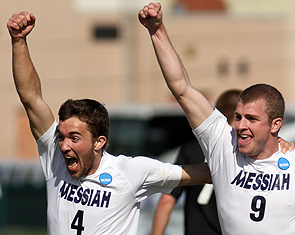 D3soccer.com did a preseason Top 25 for the first time this year and it's
hard to argue with choosing the defending and 8-time champion Messiah as preseason favorite. Yes, they
lost two All-American midfielders who combined for 16 assists and
31 goals, 15 which were game-winners, but replacing top players and
returning to the Final Four is what Messiah has been doing for a
decade now. It will be interesting to see how quickly Messiah
adjusts to life after Pezon and Nick Thompson, and that might
depend on how effective target forward Josh Wood can be coming back
from a whole season lost to injury and if freshman Jack Thompson, a
playmaking midfielder, can hit the deck running at the collegiate
level. Those things could be key to whether they come out the
gates looking like a No. 1 team or not.
D3soccer.com did a preseason Top 25 for the first time this year and it's
hard to argue with choosing the defending and 8-time champion Messiah as preseason favorite. Yes, they
lost two All-American midfielders who combined for 16 assists and
31 goals, 15 which were game-winners, but replacing top players and
returning to the Final Four is what Messiah has been doing for a
decade now. It will be interesting to see how quickly Messiah
adjusts to life after Pezon and Nick Thompson, and that might
depend on how effective target forward Josh Wood can be coming back
from a whole season lost to injury and if freshman Jack Thompson, a
playmaking midfielder, can hit the deck running at the collegiate
level. Those things could be key to whether they come out the
gates looking like a No. 1 team or not.
But enough already about Messiah. How does everyone else stack up going into the new season? Who was ranked and why? Who missed out and why? And did the voters get it right? Now, to be sure, meaningful preseason rankings in Division III soccer is a highly difficult proposition. It’s nearly impossible to make nationwide comparisons among 50 or so schools (the minimum that should be under consideration) never mind the 400-plus D-III schools. First, many schools do note make available information regarding incoming players and non-graduation departures. Second, the information available isn’t being compiled. And third, there are just too many schools to realistically expect anyone to do a thorough study without being paid to do so, which is largely why item two isn’t happening.
But to the extent that information is available and time is taken to make comparisons, what should be considered? Jim Matson, in his Daily Dose blog post A preseason Top 25, already listed most things to be studied: returning players, new players, variables from last season’s success or failures, and schedules. With returning players we want to consider more than just the quantity of players and starters but also their production and contributions. And conversely one needs to look at what a team lost—how critical were those players to the team’s success and can they be adequately replaced. I would also add class distribution: is a team senior-laden possibly indicating experience, leadership, and composure? Finally, given the difficulty of the task, I would suggest letting the conferences’ pre-season coaches’ polls inform the ranking. Coaches will know much more about lost and returning players and the relative strength and potential of their conference rivals than someone from another conference or region. You can’t ignore a solid conference’s favorite, and likewise caution should be taken before ranking a school that is only expected to be third or fourth best in their conference.
Working along those lines, there’s a few schools that I want to highlight because I think they have a very good shot to exceed the voters’ expectations.
 If you wanted to make the case for another school as the
pre-season #1, you can make a credible case for Christopher Newport. In 2010 the Captains were
receiving first place votes all season long, holding the #1 ranking
for a few weeks in the middle part of the regular season.
Entering the tournament as the #2 ranked team, they bowed out
to Johns Hopkins on a double-overtime goal in the second round and
at 20-2-1 (4th best in D-III) were tabbed #11 when the dust had
settled on the season. The squad returns eight starters from
last years' campaign, including five 1st team and two 2nd team
all-conference selections, three NSCAA All-Region selections, and
two D3Soccer.com All-Americans: forward Winston Mattheisen (10g, 8
a) and midfielder Brian Lybert (10g, 15a). So, unlike
Messiah, their top two attackers are back. Overall, over 80%
of their offensive production in 2010 returns (54 of 65 goals, 52
of 58 assists). And not only are the top players back, but
they are predominately seniors including a third-year starter in
goal. This team is tournament tested (Elite 8 in 2008 and
2009), beat Trinity in Texas last season and might be the strongest
Captains team ever.
If you wanted to make the case for another school as the
pre-season #1, you can make a credible case for Christopher Newport. In 2010 the Captains were
receiving first place votes all season long, holding the #1 ranking
for a few weeks in the middle part of the regular season.
Entering the tournament as the #2 ranked team, they bowed out
to Johns Hopkins on a double-overtime goal in the second round and
at 20-2-1 (4th best in D-III) were tabbed #11 when the dust had
settled on the season. The squad returns eight starters from
last years' campaign, including five 1st team and two 2nd team
all-conference selections, three NSCAA All-Region selections, and
two D3Soccer.com All-Americans: forward Winston Mattheisen (10g, 8
a) and midfielder Brian Lybert (10g, 15a). So, unlike
Messiah, their top two attackers are back. Overall, over 80%
of their offensive production in 2010 returns (54 of 65 goals, 52
of 58 assists). And not only are the top players back, but
they are predominately seniors including a third-year starter in
goal. This team is tournament tested (Elite 8 in 2008 and
2009), beat Trinity in Texas last season and might be the strongest
Captains team ever.
 A team that people should definitely keep an eye on as a potential
title contender this year is St.
Lawrence. A little over a decade ago they were national
champions and remained in the hunt for a second title through the
mid-2000's. But their star had fallen some from 2005 to 2009
to the point that few would have still named them as one of D-III's
elite programs after they missed the NCAA tournament with a 8-6-1
record in 2009. That damaged reputation was reflected by Top
25 voters largely ignoring them in 2010 until the final regular
season rankings despite amassing a 16-2-2 record and 16-game
unbeaten streak heading into the NCAA tournament. Losing to
Amherst 3-2 in the second round despite twice as many shots and
shots on goal meant a 17-3-2 record was not good enough for a Top
25 ranking. That snub possibly kept them from getting a
closer look from some of the voters this pre-season which might
suit Coach Durocher just fine to keep the team grounded. But
this team could be something special. Ten starters are back
from last year representing over 80% of their goals (36 of 44) and
assists (37 of 42) in 2010. Returning are their top five
scorers including two NSCAA All-Americans: forward Brandon Gorman
(7g, 4a) and midfielder Sam DeMello (8g, 9a). The starting
line-up figures to consist of five seniors, five juniors, and a
sophomore who started every game his first season. If they
build on the success of last year, they could be among the best in
2011.
A team that people should definitely keep an eye on as a potential
title contender this year is St.
Lawrence. A little over a decade ago they were national
champions and remained in the hunt for a second title through the
mid-2000's. But their star had fallen some from 2005 to 2009
to the point that few would have still named them as one of D-III's
elite programs after they missed the NCAA tournament with a 8-6-1
record in 2009. That damaged reputation was reflected by Top
25 voters largely ignoring them in 2010 until the final regular
season rankings despite amassing a 16-2-2 record and 16-game
unbeaten streak heading into the NCAA tournament. Losing to
Amherst 3-2 in the second round despite twice as many shots and
shots on goal meant a 17-3-2 record was not good enough for a Top
25 ranking. That snub possibly kept them from getting a
closer look from some of the voters this pre-season which might
suit Coach Durocher just fine to keep the team grounded. But
this team could be something special. Ten starters are back
from last year representing over 80% of their goals (36 of 44) and
assists (37 of 42) in 2010. Returning are their top five
scorers including two NSCAA All-Americans: forward Brandon Gorman
(7g, 4a) and midfielder Sam DeMello (8g, 9a). The starting
line-up figures to consist of five seniors, five juniors, and a
sophomore who started every game his first season. If they
build on the success of last year, they could be among the best in
2011.
 I think the voters' cautious take on Wheaton (Ill.) is sensible, but I'd guess few will be
surprised if they do much better than #24. Last year was one
of growing pains for a squad featuring 24 freshmen and sophomores
and Wheaton's typical killer non-conference schedule (three teams
finished ranked in the top 6, two more Top 25, and two more
receiving votes) was too much for the youngsters who dropped six
and tied three in posting a very uncharacteristic 2-6-3 mark before
entering conference play. That experience and the generally
easier competition resulted in the Thunder winning their next nine
in a row before losing 3-2 in overtime in the conference final to a
North Park side the had beaten 3-1 a month earlier. It meant
the team missed out on the NCAA's for the first time in 17 seasons.
As painful as that was for the Wheaton faithful, the
experience gained from the tough schedule and the sting of falling
short of the program's traditional success should propel this
years' squad to unqualified success. Those freshmen and
sophomores are now sophomores and juniors, and it should be
remembered that Wheaton was competitive in every loss or tie last
year, only once losing by more than 1 goal and going to overtime
five times. The non-conference schedule is a little more
reasonable this time around, though still among the toughest, but
it's reasonable to expect some of last year's ties to become wins
and some of the losses to become ties or wins this season.
How many will determine if this time is good or great.
I think the voters' cautious take on Wheaton (Ill.) is sensible, but I'd guess few will be
surprised if they do much better than #24. Last year was one
of growing pains for a squad featuring 24 freshmen and sophomores
and Wheaton's typical killer non-conference schedule (three teams
finished ranked in the top 6, two more Top 25, and two more
receiving votes) was too much for the youngsters who dropped six
and tied three in posting a very uncharacteristic 2-6-3 mark before
entering conference play. That experience and the generally
easier competition resulted in the Thunder winning their next nine
in a row before losing 3-2 in overtime in the conference final to a
North Park side the had beaten 3-1 a month earlier. It meant
the team missed out on the NCAA's for the first time in 17 seasons.
As painful as that was for the Wheaton faithful, the
experience gained from the tough schedule and the sting of falling
short of the program's traditional success should propel this
years' squad to unqualified success. Those freshmen and
sophomores are now sophomores and juniors, and it should be
remembered that Wheaton was competitive in every loss or tie last
year, only once losing by more than 1 goal and going to overtime
five times. The non-conference schedule is a little more
reasonable this time around, though still among the toughest, but
it's reasonable to expect some of last year's ties to become wins
and some of the losses to become ties or wins this season.
How many will determine if this time is good or great.
 After New York University's surprising emergence and
run to the Final Four in 2006 the team suffered through two losing
seasons in 2008 and 2009. That made them a surprise success
again in 2010 when they captured the UAA title (their first) before
a heart-breaking 3-2 first round tournament loss to Brockport State
after leading 2-0 a half hour in. They finished about five
spots outside the Top 25 and found themselves similarly rated in
the current pre-season poll. They sit beneath fellow UAA
rivals Emory (#10), Washington (#17), and even Carnegie Mellon (RV)
who just edged them. But the UAA coaches, who it should be
safe to assume have a better knowledge of how their teams stack up
against each other than other observers from all across the
country, selected NYU as its clear preseason favorite with five of
eight first place votes. Emory followed in second without a single
first place vote, then Rochester and Washington in third and fourth
with one and two first place votes respectively. It's not a
case of thinking the voters got it wrong with Emory and Washington,
but rather that NYU might deserve to be up there with them. All
three of those schools bring back seven starters and all three have
the bulk of their offensive output returning. All three lost
two All-UAA defenders or goalkeepers. With similar losses and
retention, the defending champions who didn't allow any goals in
conference play a year ago probably merit a little more respect
from outside their conference.
After New York University's surprising emergence and
run to the Final Four in 2006 the team suffered through two losing
seasons in 2008 and 2009. That made them a surprise success
again in 2010 when they captured the UAA title (their first) before
a heart-breaking 3-2 first round tournament loss to Brockport State
after leading 2-0 a half hour in. They finished about five
spots outside the Top 25 and found themselves similarly rated in
the current pre-season poll. They sit beneath fellow UAA
rivals Emory (#10), Washington (#17), and even Carnegie Mellon (RV)
who just edged them. But the UAA coaches, who it should be
safe to assume have a better knowledge of how their teams stack up
against each other than other observers from all across the
country, selected NYU as its clear preseason favorite with five of
eight first place votes. Emory followed in second without a single
first place vote, then Rochester and Washington in third and fourth
with one and two first place votes respectively. It's not a
case of thinking the voters got it wrong with Emory and Washington,
but rather that NYU might deserve to be up there with them. All
three of those schools bring back seven starters and all three have
the bulk of their offensive output returning. All three lost
two All-UAA defenders or goalkeepers. With similar losses and
retention, the defending champions who didn't allow any goals in
conference play a year ago probably merit a little more respect
from outside their conference.
In closing, a few schools that are probably off the radar that I think might prove to be Top 25 teams are Ohio Northern, Hamilton, Nazareth, Redlands, and Claremont-Mudd-Scripps.
Comments or feedback for the author? Email Christan Shirk.
Want to discuss this article with other fans? Opine here.