

November 30, 2016
Interview: Josh Shapiro, Tufts men's coach
|
Other Interviews:
|
Coach Michael Coven (Brandeis) | Coach Ryan Souders (Calvin) |
D3Soccer.com had the opportunity to interview the coaches of the four men’s teams heading to the Final Four. Josh Shapiro, head coach at Tufts, spoke with Ryan Harmanis about the Jumbos’ elimination-game prowess and chance for a second title in three years.
|
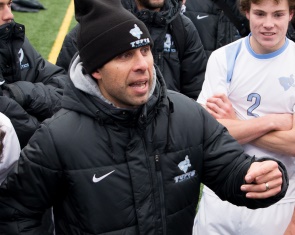
| Josh Shapiro - 7th-year head coach of Tufts Tufts Athletics |
Ryan Harmanis: Congratulations on everything, what a season. Did your guys get a chance to enjoy the break, and how did you handle the two weeks off?
Coach Josh Shapiro: Yea, thank you. We had so many guys who were already committed to flights home, and you can’t just ask everyone to cancel holiday plans like that, so we sent them off for the break, then got everyone back in for a solid week of training. We have to work the turkey out of our system [laughs], but that’s about it.
RH: So a crazy few weeks for your team. You close the regular season hot, you beat some of the top teams in the NESCAC in Amherst, Middlebury, and Williams, but then you run into Bowdoin back-to-back games. You lose 2-1 both times. I had you guys in comfortably, but did your team have a sense of where you stood?
Coach Shapiro: You know, it’s been one of those things where we’ve had to play them twice in the last few seasons. I think our guys were maybe a little anxious about the game, and they do a great job of disrupting everything we want to do. And Coach Wiercinski [at Bowdoin] does a great job and knows what he’s doing, and to his credit he seems to have us figured out. I think we felt that if we won just one of those games we’d be in good shape. But we didn’t know after losing two, so we were sweating it a bit. I thought our strength of schedule and the quality of our wins would put us in good shape, but because we’re in the NESCAC, we have fewer games, our winning percentage is lower. So if we don’t handle it perfectly we might be in a little worse shape. We were definitely worried and nervewrecked on Monday, but luckily the committee rewarded quality wins and playing a great schedule. That’s something we try to get done every year, and it payed off this year.
RH: Right, and then once you were in it just seemed like business as usual. Like last year, really tough draw early on, you have to face Rowan in the second round. That game just seemed like two really good teams slugging it out.
Coach Shapiro: Yea, Rowan was really good. Watching them on video and talking to people about them, and then they come from a really good conference in the NJAC and how well they played there, they were a very good, balanced, soccer-playing team. I think we knew we’d be defending some and we’d have to be disciplined and patient with that. But we knew that if we were sharp we could create some difficulty and challenges for them on the break. And that’s kind of how the game went. They had more of the ball, but we were threatening on the break, and I think it was just a good game.
I like how they handled things and where their program is going. They’re mostly sophomores, so they’re going to be around for several years to come, but that was a great game where we just happened to make a few more plays than they did. But I don’t think our guys really fear anyone. They respect everyone and come in with the proper mindset that these are really good teams. But really based on two years ago, dating back to that win against Messiah [1-0 in the 2014 Elite Eight], we have confidence that if we come in and do what we’re supposed to do, we can play with anybody, so we can draw on that confidence in any game at this stage.
RH: Then you turn around and get to host the Sectional. I thought it was an interesting matchup because Mass-Boston was coming off a very emotional, controversial win against Haverford, but they were missing a few key players through suspension. Sometimes those teams fold up shop, but others they circle the wagons and really come together to play tough. Did you see any of that from them? Did it make them more difficult to play?
Coach Shapiro: Maybe a little, just because we weren’t sure how they’d approach the game. But the fact is that we’ve seen them play, and they’re deep. Those are three important guys they were missing, but they still had quality all over the park. I think the bigger issue is that our players’ last impression of them was when we played from two years [an 8-0 Tufts win on the opening day in 2014]. That wasn’t reflective at all of what their team looks like this year. So I was a little worried that we might underestimate them, which would have been a very bad decision.
Frankly we came out flat and they were the better team early on. They created several chances and really had us on our heels. I think we probably respected them too much, we didn’t get up into them and close down spaces enough to start the game. I think once we started doing that, we made it harder on them and got ahold of the game and put it on our terms.
RH: So you win that and head to Sunday, and you get a rematch with Kenyon, who looked fantastic beating Trinity (Texas) [4-0]. They knocked you guys out last year [3-2 in the Sweet Sixteen] in what was one of the best games of the whole tournament. Was there anything in the back of your minds about revenge, or was it just that they’re another step on the road you’re on?
Coach Shapiro: The mindset is that we were facing a really, really good team that does a lot of the things that we do. They pressure the ball extremely well, they put numbers around it, they’re sharp in transition. They remind us of us, and they’re really good at it, probably better than we are in many respects [laughs], especially early in the year. There’s no way we weren’t going to reference last year, and look at that and say that they ended our season, now we have another shot at them. Revenge, I don’t know if that’s the right word, but there’s no way to avoid looking at last year without it sparking something in your stomach to get you ready to play.
We saw the Trinity game and we were very impressed with Kenyon. We felt they were probably the best team we’d seen all year, and that it would take an amazing effort to win. The elements on the day made it harder for a clean soccer game, but I thought it was two competitive teams working hard and the margins were very slim. Like Rowan, we just made one more play than they did.
RH: Watching that game, the wind had such an impact. But what I thought was interesting is that when you had the wind it was pretty even, not much between the teams, but your team played better against a wind. You possessed the ball better, you had more control of the game. Any guesses why that played out?
Coach Shapiro: When we set up for that game, Kenyon presses the ball so well and they work so hard defensively, we set up initially to play beyond their pressure. We wanted to get the ball forward and push back their press. But we never settled into playing in the first half. And having the wind at our back made us impatient to get forward, to shoot the ball, and so we never started playing. In the second half, with the wind in our face, you don’t have a choice. You have to get the ball down and play, and I think that helped us settle. The wind absolutely played a factor, and in the first half they were being very disruptive so they could get to the second half with the wind at their backs. We didn’t have that sort of calm to play our game after the first five or so minutes where we tried to break their press. I did think we played much better in the second half once we started passing through them and connecting the game the way we like to. It was a rugged, dogged start, and both teams were just really good defensively and swarming around the ball. Maybe more credit goes to Kenyon’s defending qualities on that front, as they were very disruptive in the first half.
RH: Let’s take the end of that game and transition to talking about your team. The winning goal was pretty straightforward. Long throw-in, flicked on, and knocked in. But the guy who scored it, Nathan Majumder, he’s been dealing with injuries all year. He scored that goal, he scored the previous weekend, how big of a lift is he giving your team?
Coach Shapiro: Oh, it’s massive. If you looked at our team coming into the fall and picked out players important to our success, he would have been one or two on the list. He was an all-region player last year, he scored eleven goals, he’s our dominant attacking player. But then he’s battling concussions for over a month. Thankfully Gaston Becherano stepped up, and he’s had a wonderful senior year, 12 goals, 7 game winners, it’s an outstanding return. Now we have Nathan Majumder back and firing at his normal level.
So what we really have at the moment is 90 minutes of quality in the center forward channel. And that makes us more dangerous because there’s no drop-off when Nathan comes out, when Gaston comes out. You can also protect them both, because you can play with full energy, because neither of them have to play 80, 90 minutes. So we have no drop-off, and they each offer something a little different, but they both have a number of ways they can score. It’s a two-headed monster that allows us to be dangerous from the point at all times.
RH: At the other end of the field, Kenyon really puts pressure on goalkeepers with crosses, set pieces, etc. I remember Scott Greenwood in goal as a sophomore, and what he was really known for was his shot-stopping. It’s not that crosses were a weakness, they just didn’t stand out as a strength. You watch him now, last weekend, he was dominant in the air. What’s his development been like as a goalkeeper?
Coach Shapiro: Scott’s come a long way. He was a very talented young guy coming in, and he’s played four years, but I think that’s been either his Achilles heel or people’s perception of a weakness. And there have been times, yes, where he’s lacked a little confidence in that area. But when he comes and gives our back four more room to work and lets them know that he’s controlling everything behind them, and he’s got very sure hands. At the end of the of day, shot-stopping is his calling card. He makes an unbelievable [one-on-one] save at the start of the second half against Kenyon, me makes two or three unbelievable saves against Rowan, so we aren’t making it through clean in the NCAA tournament without his quality in the net. We believe in him, and our guys take confidence from his swagger back there. You have to have quality in every line, and certainly to have your goalkeeper make plays for you in the NCAA tournament, and Scott Greenwood has done that for Tufts.
RH: Looking to your back line, they’ve been airtight against everyone. You shut out Kenyon, you shut out Rowan, you shut out Springfield and Mass-Boston, these are teams that are used to scoring a lot of goals. They have All-Americans in attack positions. I know Daniel Sullivan gets a lot of press, rightfully so, but talk about how the back four keeps everything locked down.
Coach Shapiro: I think our group, collectively, has just been outstanding. When we were losing games early in the season 1-0, we were a bit frustrated with our attacking qualities, because we were creating chances but not converting them into goals. So that group in the back just decided, “We’re not going to give up goals anymore.” If we can do that, obviously we won’t lose games, and so they’ve decided as a group that they are simply not going to concede. So they’ll try to join the attack and get forward, and to be dangerous on set pieces, but at the end of the day, they’re defenders first, and they’ve bought into the gritty nature of defending. They decided, “We’re going to block shots. We’re going to clear balls properly. We’re going to protect each other, make plays on and off our feet, and make it really hard on every team we play, all the time.” They’ve totally bought into that.
Dan Sullivan is an athletic beast, he’s got such a strong mentality. He doesn’t lose much in the air, he doesn’t lose much in the tackle, he doesn’t lose many foot races. I think the guys around him have bought in the same way. Conor Coleman next to him is such a great leader, he’s a really gritty personality as a defender. And Sterling Weatherbie has stepped in at right back, you know, Matt Zinner had an injury early on, and he’s just been absolutely brilliant there. And then Stephen McMillian and Zinner have been really good on the other side. We’ve got a lot of guys with experience back there and have bought into defending first, putting up zeroes, and then good things happen.
RH: Looking at the season as a whole, then, you had a rough start, 0-2-1. Was there anything in particular where the team sat down and said, “Okay, we need to start winning games”? Or was it just as simple as getting the goals flowing?
Coach Shapiro: I think it was a little bit of recognizing that we aren’t who we were. We were trying to find our identity as a team, and we were missing it a little bit. Losing two attacking center midfielders and then both outside backs really took away the core of how we played. So now you have new guys running your offense, it just felt different. So figuring out how it was going to work, how we were going to do it, it took us a little while to iron it out. We maybe aren’t as fluid an attacking team as we were last year. But I think we’re deeper, I think we’re physically tougher, and I think we’ve got a better diversity of ways to come at you. And that may be a reason why we’re here, is that this year it’s not as aesthetically pleasing, but this group can grind. And grinding gets you results this time of year. This group has a lot of belief in who we are, and now that we’ve found that identity, we’re going to stick to it.
RH: On your philosophy then, and we discussed it in 2014, what stood out to me was marrying that aesthetically pleasing, deadly attacking group with the steel to shut down a game. You can score on No. 1 Messiah in 2014 in the first five minutes and make it stand up for the whole game. So is it the same, with little tweaks for personnel, or has anything changed about your philosophy.
Coach Shapiro: Exactly, and there’s been no change. Coming out of our conference, there are teams every year that are going to put you on your heels. You just can’t win every year, and get all the way to the Final Four, without being able to attack and defend. I think our philosophy is to be sound defensively from back to front. And then to have the ability to play, to open teams up and create goals in different ways.
But I think you can’t get through a season—we learned this last year after the title, teams aren’t going to let you just do what you want to do. You have to find different ways to get at teams. So hopefully one day you can put together a 30-pass movement and create chances, another day you have to do it on the break, another day your defense has to hold it down, and another you score on set pieces. You’ve gotta be able to do it in different ways, and embrace that every game is going to be different. So we’ll have to figure it out what it takes on the day. But we have guys that are adaptable, guys that can play different roles, and then we have different personnel to give us many different options and ways to create scenarios for our team.
RH: Looking toward next weekend, you now have the experience from 2014, so what do you take from that experience? Will you change anything in your preparation or approach?
Coach Shapiro: Frankly, the weekend is different. There’s more going on, there are more obligations, we don’t travel a ton, so there are different elements. But ultimately you want to replicate an environment where your guys are comfortable and they’re doing what they do. You don’t want to have to play differently in a Final Four game than a Sweet Sixteen or a league game. We have to find that calm and get the jitters out and help the guys find the same mental state that’s worked for them for the last three weeks. So I think if we can stay calm, reference our upper classmen and our staff, who have been in this situation before, and help the guys find that same mindset, we’ll be ready to go. On the day, it’s really anybody’s game.
RH: Looking towards that game, what do you know about St. Thomas, and how do you see that game playing out? Some years, last year, very low scoring. But when you won it, tons of goals. What do you see from them when you match up?
Coach Shapiro: I think they’re good. I think they’re really good. They have a program that’s on the rise, they have a coach who has a great legacy of programs through Ohio State and Wake Forest, they’ve won 20 games and lost only one. So they’re obviously very, very capable, and they have goal scoring from all over the place, from strikers and midfielders and defenders. So they’re potent going forward.
It’s going to be a game that requires 90 minutes of concentration, if not more than that. You look at how many games they’ve come back in, especially late, so if anything you know that team has a lot of belief. And they’re going to make you play whistle to whistle. So our guys need to be ready to be accountable and hard working and composed throughout the entire period of play. I think it’s going to be a really good game. Both teams like to attack and defend, both teams try to get it down and knock it, and play an attractive brand of soccer, and hopefully it’s a great showpiece for Division III soccer.
RH: Going back to your players, every team has Majumder, Becherano, guys scoring the goals, but they also have guys who don’t get the recognition. Is there anyone specific on your team that has filled that role, flown under the radar, but is vital for your team’s success?
Coach Shapiro: I don’t know if he’s flown completely under the radar, he’s been here awhile, but Zach Halliday is our midfield leader and general. He’s as good a leader as I’ve ever had, and may ever have. He’s the guy that everyone totally respects, he’s the one people look to for a word of advice, for reinforcement, for fire, whatever we need. He’s our general, and we go as he goes. It’s uncanny how, when you put him in a team, even in training, when you aren’t sure about the guys around him, he makes it go. He gets everyone around him on the same page and flowing in the same direction and people listen and respond to him. Again, as good a leader as I’ve ever had, and incredibly important to our ability to do what we want to do on the field.
RH: Last question. If there’s one specific thing you need to do well Friday and Saturday to succeed, what would it be?
Coach Shapiro: It’s sort of two stages. We have to try to play the game on our terms, to be the Tufts team that got to this stage. That fulfills our ideals, and the biggest thing is collectively having the right mentality to defend as an eleven. Everyone defends together, from our strikers back to our goalkeeper, and everyone who steps on the field puts in a shift to contribute to that. Offensively, let’s trust each other and enjoy it. Let’s get it down and play, and be positive with our soccer, and take risks to score goals. It takes risks to get into advanced areas, to put in a cross, to leave your feet to get on the end of it, to take shots. So hopefully our guys are playing with confidence, to go and try to make plays offensively, and have that dogged work rate and to defend for 90 or 110 minutes.
RH: Great. Good luck, Coach.
Tufts (13-5-2) faces St. Thomas (20-1-3) in the first NCAA Men’s Semifinal at 11:00 AM on Friday, December 2nd.
|
Other Interviews:
|
Coach Michael Coven (Brandeis) | Coach Ryan Souders (Calvin) |
Comments or feedback for the author? E-mail Ryan Harmanis.